

20
Mar 2025
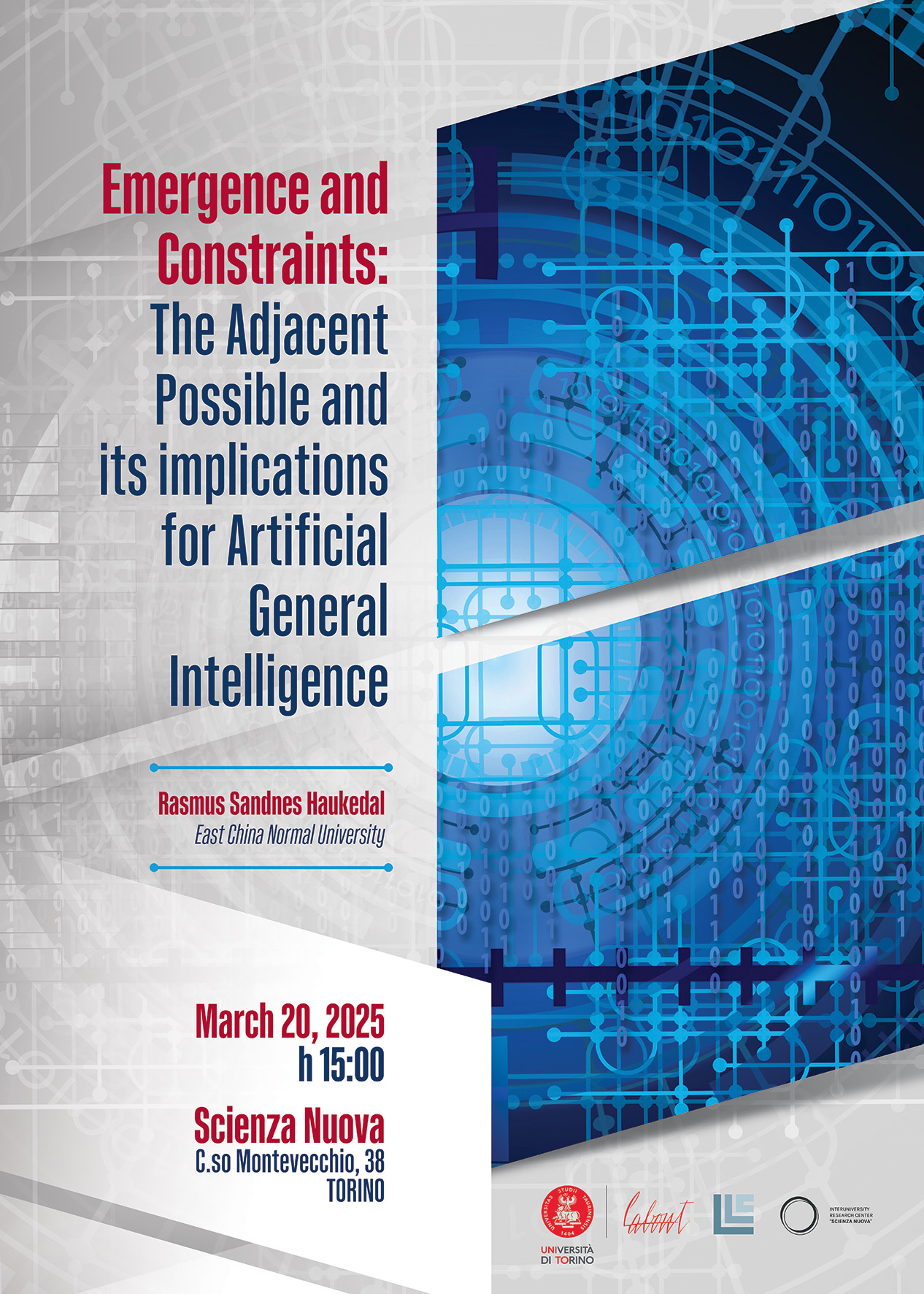
Emergence and Constraints: The Adjacent Possible and its Implications for Artificial General Intelligence
Scienza Nuova, corso Montevecchio 38, Torino
March 20, 2025
Emergence and Constraints: The Adjacent Possible and its Implications for Artificial
General Intelligence
The speaker Rasmus Sandnes Haukedal is a postdoctoral researcher at the East China Normal University, under the guidance of Shijun Tong. He can be reached at rashaukedal@gmail.com, or Weixin: Sagan23
Time of the seminar: 15:00
About the seminar: In this paper, I discuss issues related to predicting the future and how this impacts our
understanding of change through Stuart Kauffman’s notion of the Adjacent Possible (Kauffman
2002). This concept, formulated within complex systems theory, is partly inspired by Ludwig
Wittgenstein’s rule-following paradox, which states that possible rules cannot be predefined based
on previous use. In other words, there is a paradox in language rules related to their open-
endedness. This principle applies to systems at different levels, with the problem intensifying as
system complexity increases.
The Adjacent Possible implies that future possibilities are constrained and enabled by what
currently exists, yet whatever emerges cannot be predicted based on the present space of
possibilities. This space cannot be pre-stated; only in retrospect can we see how it was enabled by
the past. Kauffman’s principle thus concerns strong or ontological emergence, where emergent
properties cannot be reduced to their base, even though they depend on it. In other words, such
properties are both dependent and autonomous (Wilson 2015). This view challenges approaches that
depend on defining the possibility space in advance, which are predominant in scientific
methodologies.
It also affects how we understand intelligence. In living organisms, intelligence involves
‘situational reasoning, taking perspectives, choosing goals, and an ability to deal with ambiguous
information’ (Roli, Jaeger, and Kauffman 2022). It requires the ability to identify and exploit new
affordances (possibilities for action)—to make novel use of the environment in ways that cannot be
predefined or treated algorithmically. This broader and more open-ended definition of
intelligence has strong implications for the possibility of generating artificial general intelligence
within an algorithmic framework.